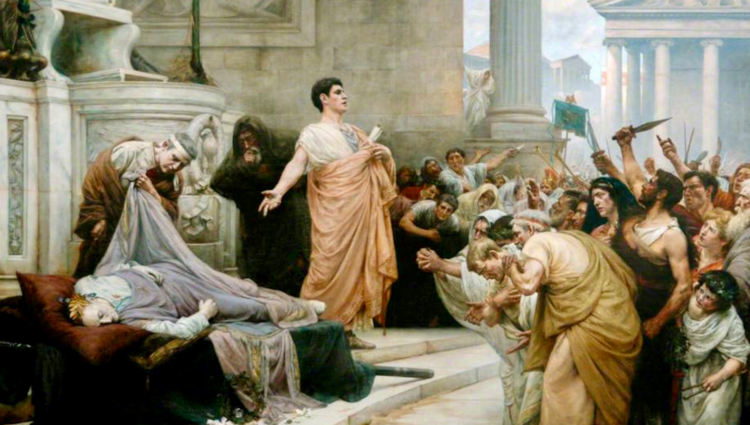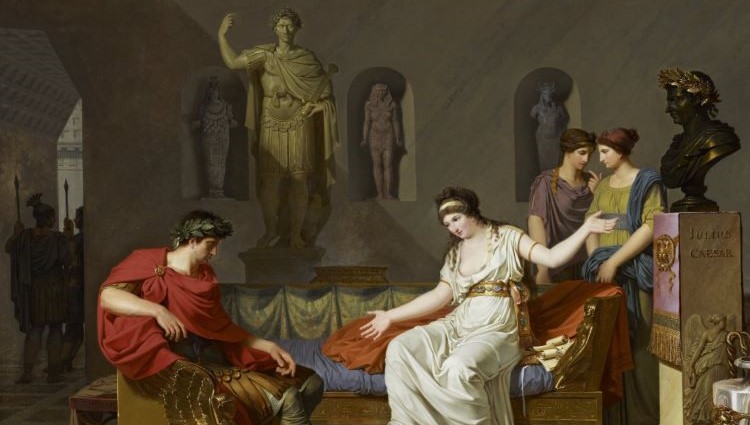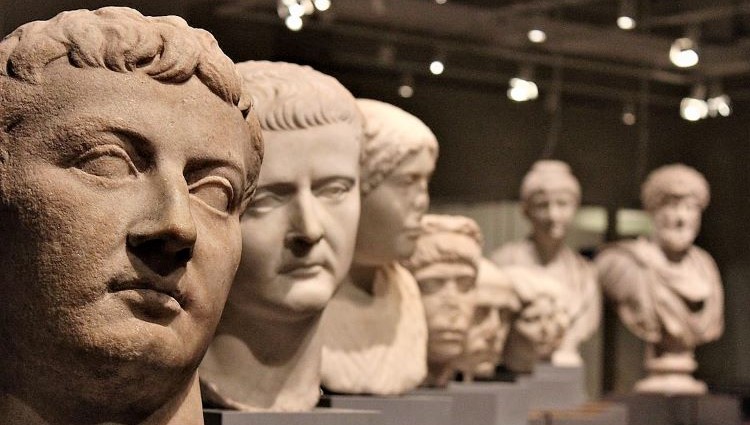
“Beware the Ides of March!” Thus the soothsayer warned Emperor Julius Caesar on the 15th of March, 44 B.C. On that day, Caesar, who had overturned the Roman republic and made himself a tyrant, was assassinated by a group of Senators, including his friend, Brutus. In the eponymous play by William Shakespeare, the Senators begin to stab Caesar, who tries to resist the assault until he sees Brutus also wielding a knife against him. “Et tu, Brute?” Caesar utters in disbelief before collapsing. [Read more...]
The Fall of Rome
by Will Durant
A great civilization is not conquered from without until it has destroyed itself within. The essential cause of Rome’s decline lay in her people, her morals, her class struggle, her failing trade, her bureaucratic despotism, her stifling taxes, her consuming wars.
–Will Durant in Caesar and Christ [Read more...]
A Teaching for [r]epublicans: Roman History and the Nation’s First Identity
by M. E. Bradford
The Federal District of Columbia, both in its formal character as a capital and also in its self-conscious attempt at a certain visual splendor, is, for every visitor from the somewhat sovereign states, a reminder that the analogy of ancient Rome had a formative effect upon those who conceived and designed it as their one strictly national place. What our fathers called Washington City is thus, at one and the same time, a symbol of their common political aspirations and a specification of the continuity of those objectives with what they knew of the Roman experience. So are we all informed with the testimony of the eye, however we construe the documentary evidence of original confederation. So say the great monuments, the memorials, the many public buildings and the seat of government itself. So the statuary placed at the very center of the Capitol of the United States. And much, much more. [Read more...]
Will We Learn from Rome?
The rise of Rome from a crossroads town to world mastery, its achievement of two centuries of security and peace from the Crimea to Gibraltar and from the Euphrates to Hadrian’s Wall, its spread of classic civilization over the Mediterranean and western European world, its struggle to preserve its ordered realm from a surrounding sea of barbarism, its long, slow crumbling and final catastrophic collapse into darkness and chaos—this is surely the greatest drama ever played by man; unless it be that other drama which began when Caesar and Christ stood face to face in Pilate’s court, and continued until a handful of hunted Christians had grown by time and patience, and through persecution and terror, to be first the allies, then the masters, and at last the heirs, of the greatest empire in history. [Read more...]
Among the Ruins of Carthage
by Russell Kirk
Nowhere are Roman ruins thicker than in Tunisia. For this, from the days when Scipio took Punic Carthage until the Vandals broke into the city, was the Province of Africa, wondrously rich and populous. St. Augustine was born in Carthage — of a patrician family — and died in neighboring Hippo, when the Vandals were at the gates.
A Great Civilization is not Conquered from Without
A great civilization is not conquered from without until it has destroyed itself from within. The essential cause of Rome’s decline lay in her people, her morals, her class struggle, her failing trade, her bureaucratic despotism, her stifling taxes, her consuming wars.
Will Durant, Caesar and Christ
Books by Will Durant may be found in The Imaginative Conservative Bookstore. Essays by Dr. Durant may be found here. [Read more...]
Will Durant on the Fall of Rome
A great civilization is not conquered from without until it has destroyed itself within. The essential cause of Rome’s decline lay in her people, her morals, her class struggle, her failing trade, her bureaucratic despotism, her stifling taxes, her consuming wars.–from Caesar and Christ
Books by Will Durant, and on the fall of Rome, may be found in The Imaginative Conservative Bookstore. [Read more...]


Brad Birzer’s article