On Wing to Beauty, Wisdom & Goodness: Plato

platoby Plato

The wing is the corporeal element which is most akin to the divine,

and which by nature tends to soar aloft and carry

that which gravitates downwards into the upper region,

which is the habitation of the gods.

The divine is beauty, wisdom, goodness, and the like; [Read more...]

On the Death of Plato: Eric Voegelin

Eric Voegelin

Eric Voegelin

by James V. Schall, S. J.

“But there is another sort of old age too:  the tranquil and serene evening of a life spent in peaceful, blameless, enlightened pursuits.  Such, we are told, were the last years of Plato, who died in his eighty-first year while still actively engaged in writing.”– Cicero, On Old Age [1]

In Volume III of his Order and History, Eric Voegelin reflected on the central importance of  both Plato and Aristotle.[2]  His treatise on Plato is an extraordinary analysis of Plato’s life and abiding philosophic importance.  When I ask a class to read this volume on Plato, I insist that they do not read the last short paragraph of this book until they have read the rest of the book.  I do not want them to miss the astonishment that I myself experienced on first reading it.  Too often, of course, such is human nature, this admonition not to read a designated passage has the effect of tempting most readers to read first what is not to be read until last.  This reaction is not necessarily a bad idea in reading any book, except perhaps a detective story or Voegelin’s book on Plato. 

The last paragraph of Voegelin’s treatise is a poignant account of the death of Plato.  The charm of this passage matches the spell that Plato himself sought to cast in his writings.  Plato invoked this very literary charm to incite us to pass to the higher things or at least to render us benevolent to them.  Indeed, it was his answer to Homer.  He realized that if his own style were not as intriguing as that of Homer, his philosophy would not be read by anyone except the philosophers.  And it was precisely those who were not philosophers who most threatened the life of the philosopher. [Read more...]

The Dangers of Egalitarianism in a Democracy

democracy

Louis Markos

by Louis Markos

Most Americans take for granted that democracy is an absolute good.  If it can be said of an idea or a program that it promotes equality, Americans, whatever their political affiliations, will be loath to speak ill of the idea or to protest the program.  “Of course,” they will think to themselves, “anything that fosters fairness and equal treatment must be good for society.  Should we not strive to treat everyone the same?  Is that not what America is all about?”

Well, no; at least not exactly.  America strives to be the land of opportunity, a country where citizens are afforded equal dignity and are granted a say in their government.  But the people do not control their government directly.  They elect—or elect people to appoint—leaders who will represent their needs, values, and interests.  We do so, not just for practical procedural reasons, but because we understand that there are certain people in our community whose skills for governing surpass those of their fellow citizens.  In the same way, there are individual musicians, artists, and physicians whose skills in their respective areas are superior to the skills of others who share their aspirations for music, art, or medicine. [Read more...]

The Importance of Marcus Tullius Cicero

Brad Birzer Cicero

Bradley J. Birzer

by Bradley J. Birzer

How do I define the Natural Law?  Taking my cue from Cicero–especially from On the Republic, On Duties, and On the Laws–I can state that Natural Law theory argues that there is a supreme being who holds everything together through his love or his force or his will or whatever it might be that moves him.  His will then radiates into time and creation, thus holding all things together in a brotherhood and sisterhood under his parentage.  He bestows dignity upon us by shining a part of his light into us.  We, though understanding through a glass darkly, perceive only very small parts of the infinite.  We perceive them by looking behind us, discerning what should be inherited and what should be discarded, and we look forward, deciding what should be promoted and what should be forsaken.  Through it all, we anchor our understanding to the transcendent, thus preventing any single one of us from proclaiming the status of law giver or law maker.  We are, instead, poetically, discoverers of Natural Law.  Never creators but always discoverers.  By definition, the natural law must already exist, but through our various gifts and perceptions, we see dimly and partially what has been forgotten or never been seen before. (See end note information on forum for this lecture.*) [Read more...]

The Platonic Imagery of Mumford & Sons

by Gary L. Gregg IIPlatonic Imagery

I am not someone who should ever review music, my tastes being without pattern when they exist at all. But, my students and an old friend have recently introduced me to a very intriguing band who released their second album to great fanfare in late 2012. Mumford & Sons, a quartet from west London who play a version of American folk rock music, have travelled the U.S. in their “Gentlemen of the Road” tour. Last evening a friend who has gone to their concerts described them to me as full of “20-somethings who love the music and 40-60 year olds who are there pondering the deep meaning of the lyrics.” Since I am in the latter age category, I’ve got a few thoughts about some of their lyrics which I find full of Platonic imagery and deep meaning.

This week the students in my political leadership course at the University of Louisville and I discussed Plato’s famous Allegory of the Cave and, though I don’t assume to know what the song writer meant, the parallels between the Mumford & Sons song The Cave, and the Platonic story are impossible to miss. (As are illusions to Homer and other ancient texts, but I won’t confuse things too much today).

[Read more...]

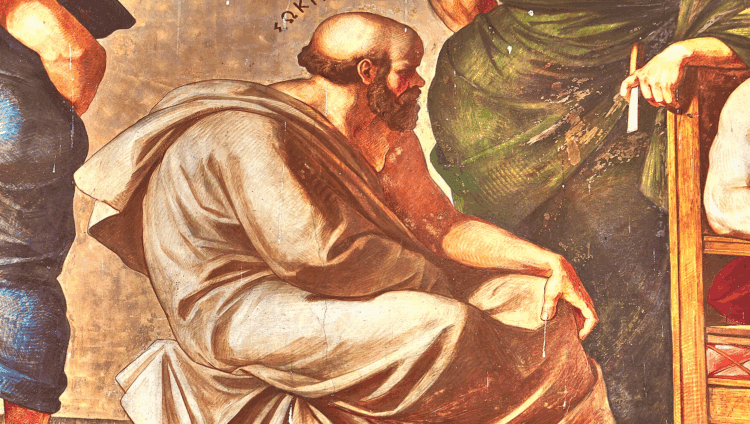
Socrates Today

by Mordecai Roshwald  

socratesSocrates, who lived from 470 to 399 B.C., is separated from us by nearly two and one half millennia. This means that he had not in common with our progressive age the automobile, the aeroplane, the television, the computer, the telephone (whether cellular or regular), video games, virtual reality, etc. Can we, then, “relate” to him? Is he in any way relevant to our lives and our problems? Can we possibly learn from him and benefit from his teaching?

On the face of it, the answer is in the negative. The gap is too wide. Moreover, had his teaching been relevant, it would well have been absorbed during the many centuries which have elapsed since his times and incorporated in the civilization into which we were born and which we continue. [Read more...]

Plato’s Apology and the Gorgias: Yearning for Political and Spiritual Regeneration

plato

H. Lee Cheek

by H. Lee Cheek, Jr.

The purpose of this essay is to elucidate the importance of Plato’s commitment to rational discourse in the Apology and Gorgias. Both dialogues chronicle the transfer of authority from the destructive world of Athens to the philosophers. The organization of politics and society, according to Plato, is determined by the orderliness of the souls of its citizens. The central element of the successful Platonic revolution is a profound yearning for political and spiritual regeneration.

In the Gorgias, like the Protagoras, Socrates must confront one of the great figures of his time, Gorgias of Leontini, who is not merely a rhetor, but an innovator of rhetorical approaches and an accomplished teacher. Werner Jaeger describes Gorgias as the man who “set the tone for the last thirty years of the fifth century” and as “the embodiment of the art” of rhetoric (Jaeger 1941, 127). But, the dialogue is more than a discussion of the uses of rhetoric. It is a treatise that describes the revolutionary transfer of political and moral
authority from the established “seat of power” in Athens to the philosophers. The revolution is existential in nature. The existential character of the dialogue evolves from a consciousness dependent on an individual awareness of life between the poles of the higher potentialities of politics and society, the perfection of the divine, and the lower potentialities, the problematic situation of humankind. The “In-Between,” the tension between the possibilities of human life and knowledge (metaxy), as the Gorgias suggests, does not fully represent human existence, but is a presentation of the struggle to participate in being.

 [Read more...]

Plato’s Timaeus and the Will to Order

plato's timaeusby Peter Kalkavage

And whoever thinks another a greater friend than his own fatherland, I say that man is nowhere.-Sophocles, Antigonê 182-3

The Timaeus is the strangest of Plato’s dialogues. It is so strange that one wonders whether anything in it can be taken seriously. Here conversation and inquiry are suspended, and in their place Plato gives us long speeches that take the form of myths. Socrates for the most part is silent. His silence is like the receptacle we hear about in Timaeus’ speech: it provides the receptive “space” for all the stories and images to come. We hear about Solon among the Egyptians, the lost continent of Atlantis, an Athens grown young and heroic, the musical construction of the soul, and the geometric construction of body. We also hear about ourselves. These are the most bizarre tales the dialogue has to offer—tall tales about our souls and bodies, about how we came to have a sphere-shaped head, a neck and torso, eyes and ears, liver and spleen, bone and flesh, an upright posture; about the manifold diseases that afflict body and soul; about where sex came from, and how birds evolved from feather-brained astronomers. With the Timaeus, even more than with other dialogues, we wonder what in the world Plato is up to. What is the point of all this cosmomania? And why is Socrates silent? [Read more...]

Politics and the Imagination

imagination

Eva Brann

by Eva Brann

The topic “Politics and the Imagination” is at once larger and more restricted than “Politics and the Arts,” the theme of this Tocqueville Forum. It is more restricted because I mean to exclude the practical problem of the relation between the arts and public life. Indeed, by politics I mean here not the working processes by which public affairs are carried on, but a fundamental sphere of human interest, namely that which is concerned with the well-being of a whole civic community as a whole. I think that in this country even politicians in the narrow sense, who are absorbed in the machinations of power, have some inkling of this meaning of politics, while it plays a large role in the thinking of all people who regard themselves as citizens. 

On the other hand, the topic “Politics and the Imagination” is larger than “Politics and the Arts” because, although almost all works of art are works of the imagination, not all imagining actually results in works of art; for example, dreams and daydreams have no actual product. [Read more...]

Plato Yes, Radical Environmentalism No

environmentalism platoby Lee Cheek

Lane, Melissa.  Eco-Republic:What the Ancients Can Teach Us about Ethics, Virtue, and Sustainable Living (Princeton: Princeton University Press, 2011)

In this provocative and accessible reflection on the potential contributions of Platonic political thought to the resolution of contemporary environmental problems, Lane (Princeton) attempts to craft “an intuitive and imaginative model inspired by the ancients” (p. 6).  As a work in political theory, the book offers new insights into Plato and contemporary debates regarding climate change as well.  The book is divided into three coherent parts, each focusing on a central aspect of her interpretation.  Part one is devoted to inertia, a critique of the limitation of our current approaches to everyday life and the environment.  Instead of a simple refutation of current attitudes, Lane argues for improvement, suggesting the West can be “saved from itself” (p. 43).  Part two addresses how an improvement in our thinking about politics and society through a revitalized imagination can help offer new approaches to resolving environmental dilemmas.  Her use and explication of a moral imagination would have benefited greatly from the integration of the work of a greater variety of theorists.  Lane’s erudite integration of Plato’s Republic is a significant accomplishment.  Part three deals with initiative, or how we can respond to change. Lane argues that we must change, but how we respond to the change is the most important consideration. [Read more...]

Plato’s Republic: Impossible Polity

Plato's Republicby Eva Brann

A review of Plato’s Republic: A Study, by Stanley Rosen

Plato’s Republic, Stanley Rosen says at the beginning of his book, is “both excessively familiar and inexhaustibly mysterious.” Thus it invites ever more interpretations, not, I think, by reason of any willful indeterminacy or woolly grandeur on Plato’s part, but because a false sense of knowing the work makes us overlook telling detail. Therefore a serious fresh reading of this mother text of philosophy, psychology, politics, and pedagogy will always be of great interest.

Rosen’s study of the Republic is such a reading. It is extended—one third longer than the Platonic text itself—and densely packed with interpretations. And it is unfailingly interesting, for it is boldly conceived and strongly expressed, though its theses are moderated as good sense requires. [Read more...]

St. Augustine: Founding Philosopher of History

by Bradley J. Birzer

st. augustine philosophy of historySt. Augustine was the first Christian to offer a comprehensive Philosophy of History, which the Russian Orthodox writer Nicholas Berdyaev called nothing short of “ingenius.”[1] One of his greatest accomplishments was the sanctification of Plato’s understanding of the two realms: the perfect Celestial Kingdom and the corrupt copy. One finds this tension and conflict between this world and the next in all of Christopher Dawson’s ideas and works and in many of Russell Kirk’s. “Christian culture is always in conflict with the world,” Dawson wrote directly.[2] In more complicated form, Dawson wrote, the “conception of the sacred and the secular manifests itself at every stage of culture from the primitive to the most highly civilized and in every form of religion.”[3]  [Read more...]