The Conservative Mission and Progressive Ideology

George Carey conservative

George Carey

by George W. Carey

At the risk of seeming too parochial, I want to outline the dimensions of a problem that has been of special concern for me and other conservative students of the American political tradition, broadly defined. This concern is not as narrow as it may at first seem. Nor, by any standard, is it insignificant; it involves no less than the future direction of our nation and whether our society will retain its legacy of liberty and self-government. As I will also indicate, our tradition has long been under assault and I see no reason to believe that it will abate in this century. What is more, for reasons I will spell out, I believe that the defense and the restoration of the tradition are missions that necessarily must be undertaken by conservatives. Certainly it is safe to say that conservative scholars, in the academy and elsewhere, are best equipped for this task. [Read more...]

Back at the Libertarian Clinic

by Stephen Masty

libertarian

Dr. Himmelman dumped her files onto the common-room table, made a cup of Earl Gray and sat down heavily. It didn’t take a world-famous clinician to see that she was having a bad day.

“Looks like you’re having a bad day,” observed Barbara D’Angelo, a world-famous clinician. “Is it Charles again?” Janet shook her head no and forced a small smile as she stared into her mug. [Read more...]

The Conservatives vs. the Intellectuals?

Intellectuals

Peter Lawler

by Peter Lawler

So everyone’s talking about the article by the intellectual Russell Jacoby on the alleged fact that there are no conservative intellectuals anymore.

The article isn’t much good, in fact.  One problem is that it doesn’t really explain what an intellectual is.

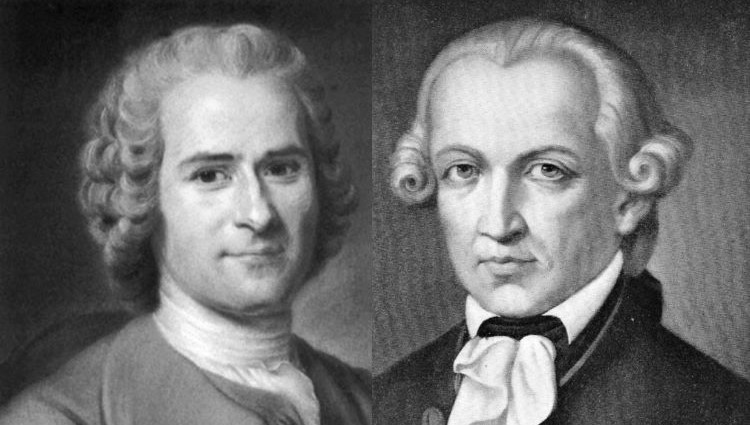
The first outstanding criticism of modern intellectuals came from the lefty philosopher Jean-Jacques Rousseau.  He explained that in a modern, sophisticated society they’ll be a “new class” of people attempting to distinguish themselves by their devotion to ideas.  They would be driven much more by vanity than love of truth or concern for others, and their main impulse would be displaying their superiority in the public square. They would be the source of the fashionable dogmas—kinds of popularized science and other forms of self-helpy expertise—that would tend to displace religion and patriotism.  The new dogmas wouldn’t really be more true than the older ones, and they would have the huge practical disadvantage of “deconstructing” moral virtue as most people experience it. [Read more...]

How Dead is Edmund Burke?

by Russell Kirk

BurkeWalk beside the Liffey in Dublin, a trifle west of the dome of the Four Courts, and you come to Number 12, Arran Quay. This is a brick building of three stories, which began as a gentleman’s residence, some time since became a shop, and now is a governmental office of the meaner sort—symbolic of changes on a mightier scale during the generations since 1729. For here in that year Edmund Burke was born. Across the river you see what once was the town house of the Earls of Moira and is now the office of a society for suppressing mendicity; and beyond that, the great Guinness brewery. Back of Burke’s house, toward the old church of St. Michan in which, they say, he was baptised, stretch tottering brick slums where barefoot children scramble over broken walls. If you turn toward O’Connell Street, an easy stroll takes you to the noble façade of Trinity College and the statues of Burke and Goldsmith; to the north, near Parnell Square, you may hear living Irish orators proclaiming through amplifiers that they have succeeded in increasing sevenfold the pensions of widows, a mere earnest of their intent. And you may reflect, with Burke, “What shadows we are, and what shadows we pursue!” [Read more...]

What Sort of Despotism Democratic Nations Have to Fear

by Alexis de Tocqueville

Alexis de Tocqueville

Alexis de Tocqueville

An excerpt from Democracy in America.

I had remarked during my stay in the United States that a democratic state of society, similar to that of the Americans, might offer singular facilities for the establishment of despotism; and I perceived, upon my return to Europe, how much use had already been made, by most of our rulers, of the notions, the sentiments, and the wants created by this same social condition, for the purpose of extending the circle of their power. This led me to think that the nations of Christendom would perhaps eventually undergo some oppression like that which hung over several of the nations of the ancient world.

A more accurate examination of the subject, and five years of further meditation, have not diminished my fears, but have changed their object.

No sovereign ever lived in former ages so absolute or so powerful as to undertake to administer by his own agency, and without the assistance of intermediate powers, all the parts of a great empire; none ever attempted to subject all his subjects indiscriminately to strict uniformity of regulation and personally to tutor and direct every member of the community. The notion of such an undertaking never occurred to the human mind; and if any man had conceived it, the want of information, the imperfection of the administrative system, and, above all, the natural obstacles caused by the inequality of conditions would speedily have checked the execution of so vast a design. [Read more...]

Maverick Conservatism & Willmoore Kendall

by Douglas A. Ollivant

Willmoore Kendall: Maverick of American Conservatives, edited by John A. Murley and John E. Alvis; foreword by William F. Buckley, Jr., 2002.

Willmoore Kendall (1909-1967) remains one of the most important figures in mid-twentieth century conservatism. His penetrating scholarship on Locke, his writings on the internal tensions inherent in majority rule, his early involvement with National Review, and his role in founding the graduate school at the University of Dallas are achievements that one might expect to have cemented his place in the cultural memory of the Right. Yet, as the first full essay in this collection reminds us, Willmoore Kendall has not been “abundantly remembered.” Despite his forceful presence at critical moments in the development of American conservatism, Kendall produced neither disciples nor a legacy in the manner of a William F. Buckley, Leo Strauss, Eric Voegelin, or Russell Kirk. The clear intent of this collection is to remedy this lacuna in our intellectual history, at least partially.

The world “collection” is here used deliberately. This work is not a book in the traditional sense, nor even a volume of assembled essays (the editors themselves note in the preface that “this is not a conventional book”). Instead, this collection is as eclectic as the man it honors, consisting of a foreward and a preface, seven essays exploring various aspects of Kendall’s life and work, the surviving correspondence between Kendall and Leo Strauss, and a reprinting of Kendall’s 1967 review of the 1964 Strauss festschrift, Ancients and Moderns. While the material is, at first glance, a hodgepodge, the net effect is—in the old adage—greater than the sum of its parts. [Read more...]

A Tale of Two Cités: Mediating Associations

Mediating associations

Leo Linbeck III

by Leo Linbeck III

It was the best of times, it was the worst of times. But what is “best” for some is “worst” for others, and vice-versa.

Monday, President Obama was sworn in for his second term. This event was a “best” for his stalwart supporters, such as Congresswoman Sheila Jackson Lee, and is a sign of a bright future:

The Houston congresswoman said she is confident that the diverse faces of Texans in Washington for the second inauguration of President Barack Obama will “build the new era of Texas Democrats.” [Read more...]

The Conservative Mind After Forty Years: An Interview with Russell Kirk

by Russell Kirk, William H. Mulligan, Jr. and David B. Schock

conservative mind

Russell Kirk was a major figure in American intellectual history. His second book, The Conservative Mind, was a landmark historical study of conservative thought. The book captured a wide readership and stimulated interest in conservative ideas.

Q: I know it can be hard sometimes looking back at something that was done forty years ago, but I would like to go back today and discuss how you came to write The Conservative Mind. As you started on the project, what did you hope to accomplish intellectually?

Kirk: When I was an instructor at Michigan State University I reflected that there had been no published book on American conservative thought and I began thinking of preparing an anthology which I meant to call The Tory’s Home Companion. That passed through my mind. I was thinking of getting a doctorate and writing on some such theme and I decided to go to St. Andrew’s University in Scotland and write a doctorate on the thought of Edmund Burke. That book on Burke eventually developed into The Conservative Mind, a book about Burke and his followers and his long tradition of thought both in America and Britain. So all this came about without any very deliberate designs and changed the complexion of American thought. [Read more...]

The Swords of Imagination: Russell Kirk’s Battle With Modernity

Gleaves Whitney

Gleaves Whitney

by Gleaves Whitney

“Imagination rules the world,” Russell Kirk used to say.[1] He meant that imagination is a force that molds the clay of our sentiments and understanding.[2] It is not chiefly through calculations, formulas, and syllogisms, but by means of images, myths, and stories that we comprehend our relation to God, to nature, to others, and to the self. That is why William Wordsworth referred to the imagination as “The mightiest lever known to the moral world.” And that is why Dr. Johnson, in an earthier definition, quipped that imagination is “The thing which prevents [a man] from being as happy in the arms of a chambermaid as in the arms of a duchess.” [Read more...]

Lord Percy’s The Heresy of Democracy

Democracyby Bradley J. Birzer

A review of Lord Percy of Newcastle‘s, The Heresy of Democracy: A Study in the History of Government (London, 1954).

In 1957, Kirk published a list of “must-read” books to understand modern (meaning, as it had developed or been rediscovered in the 1950s) conservatism.

His list would not surprise most readers of TIC, but it does include a number of books that are no longer familiar to most of us. These are books that, seemingly, have not stood the test of time. This is, of course, assuming that such a test of time exists at all. Perhaps we have simply forgotten these books, and we have no right to blame time for our ignorance. Poor time. Then again, it does devour. But, that’s another topic. . . . [Read more...]

Annie Hall and la Sagrada Familia


by John Zmirak


The Bad Catholic’s Guide to the Catechism: A Faithful, Fun-Loving Look at Catholic Dogmas, Doctrines, and Schmoctrines by John Zmirak

Q: Why call this thing “Bad Catholic”?

A: Because if you take your faith seriously, you’re bound to be dissatisfied with how well you’re living it. The kind of people who insist they’re “good Catholics” invariably use that phrase as part of a sentence like “Now, I’m a good Catholic, but…” And the “but” is always a big one:
“…but I obey my conscience, not some ‘celibate’ Eyetalians over in Rome.”
“…but I own a chain of abortion clinics.” Or
“…but I just can’t accept race-mixing. It’s like bestiality.”
And so on.
People who (like my authorial role model Walker Percy) admit to being bad Catholics or Christians are typically those who examine their consciences carefully, and who try to lead penitent lives. Not that they’re raving successes at penitence either, but at least they’re trying—or trying to try. That’s spiritually much more advanced than feeling pretty durn good about yourself, and expecting that God (or the Universe) will notice.

Q: How long have you been writing these books?

A: Since 2005.

Q: How long do you aim to keep writing them?

A: Until, thanks to the decay inherent in all contingent being, like most sequels they start to suck. So far, I’ve been told that each one is a teensy bit better than the one before. That keeps the pressure on.

Q: Why write about such serious—eternal life and death—subjects in such a smart-alecky way?

A: First, because that’s simply how my mind works. Writing these books feels to me like talking, and reading them is like being seated right next to John Zmirak on an airplane. Except you don’t have to climb over me to get to the restroom; in fact, you can carry me right in there with you.

Q: But what good do such books do?

A: Modern Americans don’t lose their  faith from reading Voltaire, or even Christopher Hitchens. They lose it by watching a hundred skits on Youtube or SNL that render Christians ridiculous, something you’d be embarrassed to be associated with. The question of whether the Church’s claims are true rarely even comes up. Well, I turn that process on its head, and help people to laugh at the World, the Flesh, and the Devil—which helps them, once they’ve settled down, to give the Faith a fair hearing. And that’s really all it needs, since it’s true.

Q: Why should a non-Catholic read your book?

A: A hundred years ago, I might (had I existed) have said: “Opposition research.” But now all of us orthodox Christians are under the same kind of attack for the same set of reasons: We hold to an historic code of conduct that cuts across the grain of modern life. We don’t subscribe to what Dwight Longenecker called “utilitarian hedonism,” which seeks the greatest number of momentarily pleasurable experiences for the greatest number of people. That makes us all kind of dangerous to the smiley-faced despots who manage modern culture and government—whose rhetoric reminds me of “Wither” in C.S. Lewis’s That Hideous Strength: a pink cloud of kind-sounding verbiage that swathes a poisoned dagger.
We’re all in the bunker together.  We might as well read each other’s books.

Q: So what Protestant books are you reading?

A: I’m thinking of finally getting around to the Old Testament.

Q: So where’s this book excerpt you promised Winston?

A: Right here, from Chapter 4, The Church:

Q. The problem I have with what you’ve been explaining isn’t so much with the details. They all seem to follow, once you grant a set of very strange premises.

A: I’d say that we humans reside in some very strange premises, which we didn’t build ourselves but blundered into, like those hapless Eisenhower voters who used to visit the Addams family. By the way, I’ve always considered that a deeply Catholic show: Here’s a bunch of aristocratic, history-obsessed homeschoolers who live in a gothic house full of torture devices and actual relics, trapped in an uncomprehending Protestant suburb. Watching the reruns as a kid, I developed a real “thing” for Morticia. She ruined me for any woman whose veins don’t show through her skin.

Q: Thanks so much for sharing.

A: Here we are, shaped a lot like chimps and inclined to act like baboons, but unlike them we’re capable of building La Sagrada Familia and making films like Annie Hall—to cite just two of the high points of our species. But beyond the arts, some of us do astonishingly non-Darwinian things, like giving all our worldly goods to the poor (St. Francis of Assisi); crossing the world to care for unbelieving foreigners (St. Damien the Leper); or giving up reproduction to educate other people’s children (those thousands of sisters who used to man our Catholic schools, before they encountered Carl Rogers and absconded). We also engage in outrageously useless acts of evil, like setting up death camps (Hitler) or famines (Stalin and Mao) to attack the most productive members of our societies; or aborting our own kids by the millions, then spending billions to generate new kids in laboratories, only to leave most of them sitting in the deep-freeze like shrimp dumplings we forgot about. Any account of man’s fate that didn’t sound a little bit strange—for instance, those chipper “just-so” stories of inevitable human progress and rationality they came up with in the Enlightenment—would obviously be nonsense. Like whistling in the infinite dark. Pascal said, “Man is a reed, but a thinking reed.” More important, maybe, is the fact that he’s a self-immolating, mass-murdering, icon-painting, and warmongering reed. We need some account of that.

As that commie hack playwright Arthur Miller said, “Attention must be paid!” Or not. We could just drink another Twisted Ice Tea and settle back to watch Tosh 2.0 on Hulu till the barbarians come. Your call.

Q: You certainly like to rub the ugly truth in people’s faces.

A: I’m practicing the converse of what Christians call apologetics. That’s the art of making faith appear as reasonable as possible. What’s needed now is to show that unbelief is unreasonable. Or at least it will lead you to madness, if you think about things hard enough. Consider what I do the art of apoplectics. And it’s as serious as a heart attack.

Q: It must have really helped you with getting second dates in college.

A: Yeah, those were thin on the ground. (Real college nostalgia quote: “You’re John Zmirak? But you seemed . . . nice!”) It’s my own fault, of course: I acted prickly (that’s an adverb). The mood always broke at the moment where, apropos of nothing, a fetching young coed would volunteer that she was “pro-choice.” I’d shrug, give her a really candid look, and explain: “You know, when I say I’m ‘pro-life,’ that’s not entirely accurate. I mean, life is cheap—and they’re only babies. What I really want is to restrict women’s reproductive health care options. Fetuses are just a pretext.”

Q. How did that work for you?

A: Pretty well, actually. It filtered out the women who were into Reiki and polyamory. But that was just a side benefit. Nor was the point just to watch that oddly constipated look pass over their lovely faces. My real intent was to peel off the scab on the unexamined caricature they carried in their minds, to make them listen to their own rhetoric on someone’s else lips. They usually laughed. And that’s the point.

The chipper, individualist theory most modern people have is just plain funny—at least when you try to square it with everything else they claim to think. The average person you run into at a classical music concert or organic grocery store believes at the same time:

a) That each human being is endowed with inalienable rights, which begin with life, liberty, and the pursuit of happiness, but continue through infinite, tortuous emanations to include freedom from want, freedom from fear, and freedom of choice, then extend to things like a living wage, health care, housing, educational opportunities, racial and gender equality, and handicap-accessible restrooms. 

AND

NOT a) That human beings are the accidental result of billions of years of random cosmic and planetary accidents, followed by millions of years of undirected genetic mutations; that our brains are organic computers whose unreliable constructs result from deterministic electronic events on the submolecular level; that our altruistic instincts are driven by DNA’s drive to replicate itself; that the most successful human being in history must have been Genghis Khan, who left behind several million direct descendants; that the biggest failure had to be Jesus Christ, who lived without sex or money and died without having children.

Try holding both these thoughts in your head at the same time and you’ll have to keep them in tightly sealed containers so they don’t spill together and annihilate themselves, like matter and antimatter in a particle accelerator. To ease the strain and give the world a little glimmer of numinous “meaning,” you’ll meditate sometimes or read mystical literature exclusively (and this is key) from religions about whose doctrines you are blissfully ignorant (hence Rumi, the Kabbalah, or the Tibetan Book of the Dead). You’ll wince when evangelicals say that Jesus got them their mobile homes, and nod benignly when Oprah says that the “universe” wanted her to write her latest Tweet. You’ll give money to Planned Parenthood and to ferret shelters. You’ll think like Darwin but emote like Rousseau. Of course, when the chips are down, the meaninglessness of life will win out in the end. When Annie Hall is over, and Mia Farrow is shouting at you, “You’re not supposed to BLEEP the kids,” you’ll shrug and say, “Why not? We’re consenting adults.”

John Zmirak blogs regularly and archives his hundreds of controversial columns at The Bad Catholic’s Bingo Hall. His new book, The Bad Catholic’s Guide to the Catechism is available at bookstores and online booksellers.


The Moral Imagination

imagination

Russell Kirk

by Russell Kirk

What is this “moral imagination”? The phrase is Edmund Burke’s, and it occurs in his Reflections on the Revolution in France. Burke describes the destruction of civilizing manners by the revolutionaries: In the franchise bookshops the shelves are crowded with the prickly pears and the Dead Sea fruit of literary decadence. Yet no civilization rests forever content with literary boredom and literary violence. Once again, a conscience may speak to a conscience in the pages of books, and the parched rising generation may grope their way toward the springs of moral imagination. The first annual lecture at this new Center for the Study of Christian Values in Literature is an endeavor to describe that high power of perception and description which has been called “the moral imagination,” and to relate that imagination to what Chateaubriand called “the genius of Christianity.” What once has been, may be again. [Read more...]