Logotherapy: Man’s Search for Meaning

By |2026-01-11T13:23:30-06:00January 10th, 2026|Categories: Classical Education, Education, Goodness, Liberal Learning, Literature, Philosophy, Socrates, Truth|

Now we’ve always been a happiness oriented culture. “Life, liberty and the pursuit of happiness” and so forth. Right? But it’s taken a particularly interesting turn: the topic of “meaning” and “meaning in life” is coming to the fore. People, more and more, are talking about not just sheer contentedness, but what it is for [...]


Love Is All You Need: Motive Power of Western Civilization

By |2025-12-28T18:50:12-06:00December 28th, 2025|Categories: Ancient World, Bradley J. Birzer, Christianity, Goodness, Love, Modernity, Senior Contributors, Socrates, Western Civilization, Western Tradition|

In the modern world, love is often ignored or perverted into lust. When we talk of governance, when we talk of relationships, when we talk of societal structures, we never mention love. What happened? How could the modern West be so very different from the ancient and medieval West? One of my greatest joys in [...]

Caves, Happiness, and Liberal Learning

By |2025-12-09T10:31:08-06:00December 8th, 2025|Categories: Eva Brann, Liberal Learning, Plato, Socrates, St. John's College, Timeless Essays, W. Winston Elliott III|

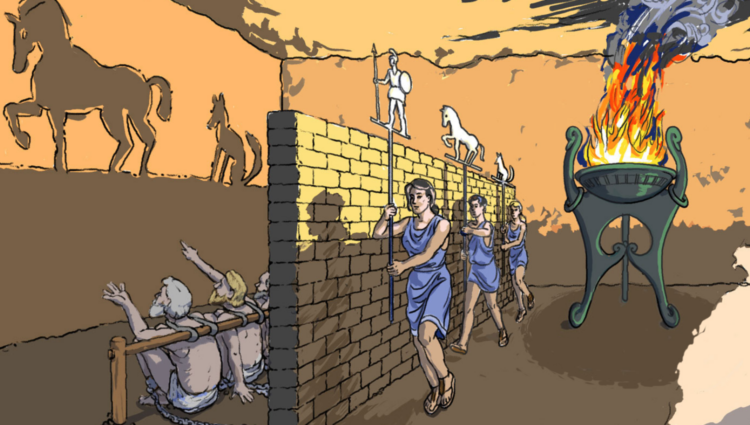
If Plato’s extended metaphor of the mind as depicted by the city is true, every human mind has the capacity to train its Guardians, curb the appetitive part of the soul, and live on the grassy plains in the sun above the cave. It’s a question of true learning. When Eva Brann describes a liberal [...]

Socrates, Cicero, & the Meaning of Citizenship

By |2025-10-08T20:27:20-05:00October 8th, 2025|Categories: Bradley J. Birzer, Citizenship, Conservatism, Edmund Burke, Liberal Arts, Senior Contributors, Socrates, St. Paul|

We modern defenders of the liberal arts have to choose between Socrates’ vision and Cicero’s vision: Are we citizens of a particular soil and a particular place, or are we connected—across time and space—to all good men and God? A few weeks ago, I had the grand privilege of attending a Liberty Fund conference on [...]

Socratic Dialectic in the Classroom

By |2025-08-13T10:41:15-05:00August 12th, 2025|Categories: Education, Socrates|

If a liberal education liberates, one of the constraints from which the student is liberated is the professor. That this occurs from a method exercised by the professor is one of the great powers of Socratic dialectic in the classroom, and one of the paradoxes, perhaps mysteries, of our privileged vocation in the university. Why, [...]

Why Should We Read?

By |2024-10-31T13:14:05-05:00October 30th, 2024|Categories: Books, E.B., Eva Brann, Featured, Great Books, Plato, Senior Contributors, Socrates, St. John's College|

Reading presents thoughts as gifts, and the best books, by preventing us from passively succumbing to other people’s pictures and their self-serving agendas, cooperate in saving our souls. You’ve all probably heard the expression “preaching to the choir,” which means trying to persuade the faithful of what they already believe. The opposite of preaching to [...]

Glaucon’s Fate: History, Myth, and Character in Plato’s “Republic”

By |2024-05-17T12:26:49-05:00May 17th, 2024|Categories: Books, Character, Culture, History, Myth, Philosophy, Plato, Socrates, Timeless Essays|

Glaucon’s story is part of a well-known political tragedy that swept up many of Plato’s friends and fellow citizens, including Socrates. The evidence for his personal tragedy, however, is deeply embedded in the text. Like a three-dimensional image hidden within a two-dimensional picture, it requires a special adjustment of the eyes to perceive. Perhaps the [...]

Tradition: The Concept and Its Claim Upon Us

By |2024-05-03T18:36:00-05:00May 3rd, 2024|Categories: Culture, Philosophy, Plato, Socrates, Timeless Essays, Tradition, Western Tradition|Tags: , |

True unity among men must have its roots in that common participation in the holy tradition reaching back to an utterance of God Himself. One wonders whether tradition is not actually anti-historical. It stands in stark contrast to the most impressive and most visible strand of the historical process, namely, the ever-advancing scientific investigation of [...]

Turning the Whole Soul: The Moral Journey of the Philosophic Nature in Plato’s “Republic”

By |2024-03-17T16:52:56-05:00March 17th, 2024|Categories: Andrew Seeley, Culture, Education, Philosophy, Plato, Socrates, Timeless Essays|

According to Socrates, to save Philosophy, to save young souls destined for greatness, to save human society itself, the true, philosophic nature must be freed from the corruptive influences that have formed him and receive the best education. The soul must be turned around. I forgot that we were playing and spoke rather intensely. For, [...]

Image, Being, & Form in the Platonic Dialogues

By |2023-06-26T16:55:38-05:00June 26th, 2023|Categories: Books, E.B., Eva Brann, Featured, Jacob Klein, Plato, Senior Contributors, Socrates, St. John's College, Timeless Essays|

Modernity is best apprehended as being in a ruptured continuum with Greek antiquity—a continuum insofar as the terms persist, ruptured insofar as they take on new meanings and missions. That perspective makes those who hold it avid participants in the present. Jacob Klein was in the last year of his nine-year tenure as dean of [...]

A Backwards Civilization: Unthinking Leaders, Frenzied Citizens

By |2023-02-07T17:08:49-06:00February 7th, 2023|Categories: Civil Society, Civilization, Democracy, Featured, Meno, Modernity, Plato, Political Philosophy, Politics, Socrates, Timeless Essays|

In America today, we are living in a toxic political climate that is the product of a very dangerous combination: Our rulers lack the learning necessary to ask the kinds of deep and fundamental questions that leaders and lawgivers ought to make a habit of pondering, while our people rebelliously scrutinize all orthodoxies and impose [...]

Plato’s “Timaeus” and the Will to Order

By |2022-11-11T22:08:39-06:00November 11th, 2022|Categories: Books, Classics, Featured, Peter Kalkavage, Philosophy, Plato, Socrates, St. John's College, Timeless Essays|

Plato, through the drama of the “Timaeus,” reminds us of the dangers of being human as well as the dangers of philosophy. Danger and safety, perhaps the most central terms of the Platonic dramas, become central because of Plato’s care for what we do and what we suffer. And whoever thinks another a greater friend [...]

Go to Top