The Blackstonian Causes of the American Revolution

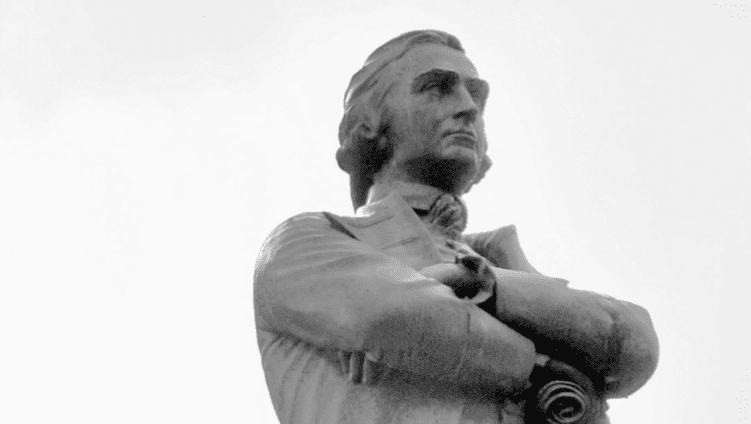
Sir William Blackstone blackstonian

Sir William Blackstone

by Richard Samuelson

William Blackstone (1723-1780), the great English jurist, did not cause the American Revolution. Had he not published his Commentaries on the Laws of England in the late 1760s, the American Revolution would have taken place. Blackstone did, however, represent certain trends in the law and in British society that, when combined with the evolving colonial situation of the 1760s led to American independence. Unrest in the empire took place at the junction of politics, culture, and ideas as Anglo-American nationalism, the transition to constitutional positivism, and the desire to reform colonial administration in the 1760s rendered the empire unworkable. After the Seven Years War, Blackstone’s doctrines made it difficult to finesse the tension that had always existed between the liberties of the colonial periphery and governance from the imperial center. [1] [Read more...]

The American Republic and the Long Shadow of Rome

rome american republicby Stephen M. Klugewicz

“Beware the Ides of March!” Thus the soothsayer warned Emperor Julius Caesar on the 15th of March, 44 B.C. On that day, Caesar, who had overturned the Roman republic and made himself a tyrant, was assassinated by a group of Senators, including his friend, Brutus. In the eponymous play by William Shakespeare, the Senators begin to stab Caesar, who tries to resist the assault until he sees Brutus also wielding a knife against him. “Et tu, Brute?” Caesar utters in disbelief before collapsing. [Read more...]

The Glory of Mankind: Alcohol and the Early Republic

alcoholby Stephen Klugewicz

What care I how time advances?
I am drinking ale today.
― Edgar Allan Poe

Vivan le femmine, Viva il buon vino, sostegno e gloria, d’umanità! –Mozart, Don Giovanni

We Americans like to think of the leaders of the American Revolution and the Framers of the Constitution as, literally, a sober lot. The Stoic Washington, the thoughtful Jefferson, the determined Madison are the archetypes that come to mind when we imagine what our forefathers were like. When we wish to visit the places where these men made history and where great debates among them occurred, we journey to Independence Hall in Philadelphia or the House of Burgesses in Colonial Williamsburg. [Read more...]

Virtue in Addison’s Cato

virtueby Aaron Schreck

Aeneas emerged from the flaming ruins of Troy with his father on his back, his son at his side, and his hope in the prophecy of Rome.  Bearing his household gods across the sea, he founded a new nation that eventually dominated the known world.  Although remembered as one of the greatest powers in human history, Rome began as a thing fundamentally secondary.  Its heroes and its culture came not from its own soil, but from across the Mediterranean.  The United States of America possess similar origins.  Whereas Aeneas had his household gods, these early European settlers had a rich Graeco-Roman heritage that proved instrumental in the development of early America.  With its classical setting, Joseph Addison’s Cato: A Tragedy and its cogitations on virtue spoke strongly to colonial Americans.  According to Addison, the virtuous man, unbounded by ethnicity or country, esteems the happiness and wellbeing of his peers above his own, executes justice devoid of passion, and follows truth and righteousness above all, even to the grave. [Read more...]

Our Constitutional Tradition: A Reminder

Constitutional traditionby Bruce Frohnen

Before finally agreeing to write The Roots of American Order, Russell Kirk several times remarked that there was no need for a book tracing the historical underpinnings of our civil social order.  After all, he said, every child learned the story of America’s ordered liberty and its origins in grammar school.  But Kirk relented, and that book became one of the most important of Kirk’s—or anyone else’s written in the twentieth century.  Americans as a people had, as Kirk came to realize, forgotten their debts to Jerusalem, Athens, Rome, and London.  Indeed, we had forgotten that it was even a good idea to remember one’s debts at all.  Thus, Roots is a crucial act of recovery, recapturing an understanding of ordered liberty, its development and its necessarily traditional character for those in our and succeeding generations.  Yet, in a better world Kirk would not have had to write the book at all, and might have concentrated on other tasks that assumed the knowledge he imparted therein. [Read more...]

Common Ground: The Founding Era

foundingby George W. Carey
The following is an excerpt from Georgetown professor George W. Carey’s indispensable book A Student’s Guide to American Political Thought.

A uniqueness attaches to the American political tradition that serves to provide a focus to its study. The source of this uniqueness derives from the query put by Alexander Hamilton at the beginning of the first essay in The Federalist, “whether societies of men are really capable or not, of establishing good government from reflection and choice, or whether they are forever destined to depend, for their political constitutions, on accident or force.” This, he believed, was the overriding question facing the American people at the time of the ratification struggle—and not only the American people but all mankind as well. The affirmative answer given this question with the adoption of the Constitution has served to provide a fixed point of reference for students in the field. [Read more...]

Patrick Henry Warned About Infringement on Liberty

Patrick Henry

Patrick Henry

by Thomas S. Kidd

At the conclusion of Virginia’s 1788 ratification convention, a meeting tasked with voting on the new Constitution, Patrick Henry strode to the assembly floor, convinced that the future of American liberty hung in the balance. In his mind’s eye, the great orator warned, he could see angels watching, “reviewing the political decisions and revolutions which in the progress of time will happen in America, and the consequent happiness or misery of mankind–I am led to believe that much of the account on one side or the other, will depend on what we now decide.”

To Americans familiar only with Henry’s blazing “Liberty or Death” oration of 1775, it may come as a shock to learn that Henry opposed the adoption of the Constitution. Henry always had a flair for the dramatic, but on this occasion Mother Nature offered him an improbable assist: As he thundered against the dangers of the new centralized government, a howling storm rose outside the Richmond hall. Frightened delegates scurried to take cover. [Read more...]

George Washington’s Farewell Address-Sage Advice

George Washington

George Washington

by George Washington

Friends and Citizens:

The period for a new election of a citizen to administer the executive government of the United States being not far distant, and the time actually arrived when your thoughts must be employed in designating the person who is to be clothed with that important trust, it appears to me proper, especially as it may conduce to a more distinct expression of the public voice, that I should now apprise you of the resolution I have formed, to decline being considered among the number of those out of whom a choice is to be made.

I beg you, at the same time, to do me the justice to be assured that this resolution has not been taken without a strict regard to all the considerations appertaining to the relation which binds a dutiful citizen to his country; and that in withdrawing the tender of service, which silence in my situation might imply, I am influenced by no diminution of zeal for your future interest, no deficiency of grateful respect for your past kindness, but am supported by a full conviction that the step is compatible with both…. [Read more...]

Our First Ex-President

by Steve Klugewiczpresident

As Pope Benedict XVI nears his retirement at the end of this month, questions abound as to how the Vatican—and the Roman Catholic world—will deal with the first living, former pope in more than seven hundred years. What will be done with his papal seal? (It is usually destroyed after a pope’s death.) How will he be addressed? (Aides have disagreed, one saying he will return to being known as “Joseph Cardinal Ratzinger,” whereas another says he will still be called “His Holiness, Pope Benedict XVI). More broadly, what influence will the former pope exert on his successor and the Church herself? Benedict has stated his intention to live a secluded life of prayer, “hidden from the world,” in another building on Vatican grounds. Still, how the Church hierarchy and individual Catholics respond to the fact of an ex-pope remains to be seen. [Read more...]

George Washington: Indispensable Man-Featured Book

Washington-The Indispensable Manwashington

In honor of the anniversary of George Washington’s birth The Imaginative Conservative recommends this dramatic and concise single volume distillation of James Thomas Flexner’s definitive four volume biography of George Washington. Flexner received a Pulitzer Prize citation for the four volume work. Books on George Washington may be found in The Imaginative Conservative Bookstore. (In the American Founding category see The Presidency of George Washington and George Washington: Collected Writings. Find essays related to George Washington here.) [Read more...]

The Old Republic and President Obama’s America

old republic

Pat Buchanan

by Pat Buchanan

“Second Term Begins With a Sweeping Agenda for Equality,” ran the eight-column banner in which The Washington Post captured the essence of President Obama’s second inaugural. There he declared:

“What binds this nation together … what makes us exceptional — what makes us American — is our allegiance to an idea, articulated in a declaration made more than two centuries ago.”

Mr. Obama then quoted our Declaration of Independence: [Read more...]

Founding Fathers-Lives of the Framers: Featured Book

Founding Fathers: Brief Lives of the Framers of the United States Constitutionfounding fathers

M.E. Bradford’s brief lives of the Founding Fathers, free of ideological prejudices, tell us the sort of delegates those fifty-five were: gentlemen, with few exceptions, attached to precedent and custom, prescription and “ancient constitutions.” Those colonial gentlemen, so very British, were not in the least inclined to destroy the prevailing pattern of American society. More fully than most commentators upon those Framers, Bradford has carefully examined their several religious persuasions or affiliations, discovering few Deists or unchurched… [from Dr. Kirk's introduction to Founding Fathers] Find books by M.E. Bradford and Russell Kirk in The Imaginative Conservative Bookstore. TIC offers essays by Dr. Kirk and Dr. Bradford. [Read more...]