
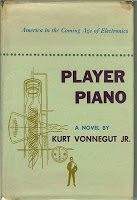
Player Piano by Kurt Vonnegut, Jr.
I have long resisted reading Kurt Vonnegut. In this life of finite time and seemingly infinite and ever expanding good things to read, his biography or writing just did not seem enough to clear the bar to justify pushing some other unread book aside. I am very glad, however, that I found the excuse and the time this winter break to read Vonnegut’s Player Piano.
Vonnegut, born in Indianapolis, Indiana in 1922, published Player Piano in 1952 (though to encourage book sales among science fiction readers, it was originally published with the meaningless title of Utopia 14). At thirty years old, this was Vonnegut’s first novel and comes seventeen years before his most famous Slaughterhouse Five. In an early 1970s interview, Vonnegut gave more than mere inspirational credit to Huxley’s Brave New World for his plot, though he also talked about his time working in a General Electric factory as providing additional source material.
Like Huxley’s classic, Player Piano takes place in a world after a war (they all take place after a war, don’t they?) in which superior engineers and mechanization have seemingly saved democracy and the lessons learned in war were then turned toward bringing “standardized progress” to domestic life. Unlike Huxley’s book, though, which is brightly painted with details and technological imagination, Vonnegut’s portrayal of a future society is flatter and feels markedly more dated.
Vonnegut’s main concern is with the price humanity will pay with ever increasing rates of mechanization and centralized planning. For him an old player piano in a dingy lower class neighborhood bar stands as the symbol of a society where machines have replaced human workers. Though there are only a few fleeting references to it in the book, one can almost see the ghost of the man whose fingers once danced on the keys to the delight of the patrons hovering now somewhere near the machine with nothing left to do. The men at the bar seem oblivious to the fact that the mechanized piano was but a forerunner for the machines whose movements ultimately took their jobs and their sense of having a useful place in the world. As the book progresses, Dr. Paul Proteus, successful engineer and manager, is finally forced to confront related questions as he is put in real contact for the first time with those on the “losing side” of technological progress.
Though lacking the prophetic ability of Huxley, including his complete lack of concern that engineers might turn their efforts directly to engineering life itself, Vonnegut’s world continues to speak profoundly to the American reader of the twenty-first century. In Vonnegut’s world older hierarchies have been replaced by a new hierarchy that echoes the direction of our contemporary celebration of STEM (Science, Technology, Engineering, and Math), a view of progress that reigns supreme in the schools and where engineers and managers hold the pinnacles of power.
As Vonnegut’s narrator explains the indoctrination process, he has one of his characters proclaim, “[T]his elite business, this assurance of superiority, this sense of rightness about the hierarchy topped by managers and engineers—this was instilled in all college graduates, and there was no bones about it.”
Every man’s future, in Vonnegut’s dystopia, is determined by standardized tests, a future that is already here in some parts of Asia and is becoming more true in this country, enamored as we are of the illusion of “meritocracy” according to some objective, scientific standard. The fiction of major college athletes being actual students is replaced by the absolute prohibition on them going to school at the same time as they represented the school on the football field. (How inefficient a “student-athlete” would be!) And, perhaps you know a school just like this—the athletes no longer are housed with the rabble students but have special accommodations outside the distractions of the students and faculty on campus.
The first industrial revolution, Vonnegut’s lead character tells us, was inspired to liberate man from the drudgery of manual labor. The second industrial revolution was inspired to liberate man from routine mental calculations. The third was inspired to liberate man from having to think at all. We live, arguably, in the second—how many of us understand the machines we use every day? How many of us rely on calculators and automated spell check? It is amongst the progress in the third period that the book takes place, a period whose organizing principle seems to be “the divine right of machines, efficiency, and organization.”
In this meditation on the consequences of the progress of engineers to liberate man under the new national trinity (efficiency, economy, quality), Vonnegut allows a few of his characters to break out of the prevailing mindset to ask the most profound of questions—what does it mean to be human? The answer, it seems, might be less important than raising the question at all. We see in Vonnegut’s novel the same unthinking drive toward “progress” that we have come to see in the modern world—especially the worlds of science and technology. The engineers and scientists do not pause to ask the essential questions, but are pulled along by the pleasure of creation and the propaganda of the central planners. Segregated from the lower classes and largely devoid of religion and the liberal arts, it is unclear whether most of the scientists or engineers or managers would even have the capacity to raise the necessary questions that might temper and humanize their work.
Like so many such dystopian novels, remnants of a past way of life serve to awaken the lead character to the possibility that life could be different and may well have once been better. In Player Piano such remnants are lying about like traps waiting to snap their prey out of his routine and ruin his (therapy supported) well-adjusted lifestyle—a rusty old gun in a disarmed society, a grungy old neighborhood bar, a craftsman’s large and once powerful old hands, the old imperfect wooden beams of an unreconstructed room where Edison once worked on his crude inventions. And there is the old farm being kept intact because of a protective easement past owners had placed on it to keep it off the grid, now tended by a man of the old ways. As I read I hoped the lead character, Dr. Paul Proteus, would settle down on this farm and assume the life and mission of a Wendell Berry, but such would not be in Vonnegut’s plan.
The consequences of a mechanized world are profoundly felt in the America Vonnegut shows us. The elite are flat-souled professionals, C. S. Lewis’s “men without chests,” obsessed with advancing their fields and climbing the management ladder. They are consummate materialists unconcerned (and largely unaware) of the spiritual price being paid by the people they serve with ever increasing levels of efficiency. The consequences may be even worse for the men and women who once toiled in the dignity of being a skilled laborer or craftsman. In their life on the public dole or impressed into service in the military or part of the “wrecks and reeks” laborers, they lose purpose and dignity. Because everyone’s place in society is determined by a standardized test, they lose the dignity of choice and much of the hope most of us have for the future, including that of our children. They mask their loss in mindless television, drug addiction, alcoholism, and sports entertainment. It turns out that man, indeed, cannot live by bread alone.
Like Huxley, Vonnegut uses American Indian imagery to show us some of what we have lost in this managed and mechanized future. The rebels, fighting against the uniformity of the centralized America are likened to the Native Americans who were faced with the choice of selling out to become second-rate white people or facing annihilation.
In the end, Vonnegut asks us to consider what people are for and what human dignity entails. In an open letter to the public, the rebel “Ghost Shirt Society” under the signature of its titular leader tells its readers that though they might find it an “antique and vain notion” that man is the creation of God,
I find it a far more defensible belief than the one implicit in intemperate faith in lawless technological progress—namely, that man is on earth to create more durable and efficient images of himself, and, hence, to eliminate any justification at all for his own continued existence.
We think of Vonnegut as a consummate man of the left, drawn mostly from the pacifist stances of such novels as Slaughterhouse Five, but at least in Player Piano he hits upon some of the major themes that have concerned thoughtful conservatives for half a century—the boredom of modernity, centralization, mechanization, the consequences of technological innovation, and the thoughtless drive toward “progress.” In our age where STEM, unburdened by concerns of ethics or metaphysics, is becoming the driving force in our educational system, where technological “progress” whirls faster than at any time in human history, where universities, government, and business interests are linked closer than ever before, and our welfare rolls have grown exponentially, Vonnegut’s Player Piano might be even more timely today than when it was published sixty years ago.
Books mentioned in this essay may be found in The Imaginative Conservative Bookstore. Republished with the gracious permission of the University Bookman.



"[H]ow many of us understand the machines we use every day?"
One of the many questions raised by Matthew Crawford in his book "Shop Class as Soulcraft: An Inquiry into the Value of Work".