Robert Frost: The Poet as Philosopher

Robert Frostby John F. Desmond

Robert Frost: The Poet as Philosopher, by Peter J. Stanlis.

Probably no other American poet has suffered more misunderstanding at the hands of his readers, admirers and detractors alike, than Robert Frost. The range and variety of misreadings of both the man and his poetry are legion: he was simply a nature poet, child of the Romantics; a clever versifier with little depth; a genial country wit; a moral monster; a cranky, iconoclastic reactionary against modernity, and so on. The problem of understanding this complex man and poet was vastly compounded by the publication of Lawrance Thompson’s three volume biography, authorized by Frost himself, which portrayed much of the poet’s life, his thought and his poetry in a glaringly simplistic and often negative light.

[Read more...]

Les Misérables: A Rousing Tale for Slumbering Souls

by Barbara J. Elliott

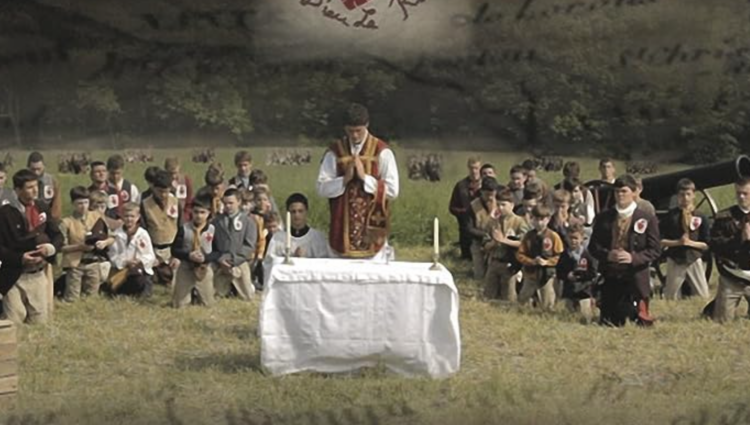
If you are allergic to emotion, this may not be the film for you. But if your heart yearns for good to triumph over evil, for beauty to emerge from squalor, and for the vindication of strong heroes who can fight, shoot, and pray, Les Misérables will be an exhilarating experience. Putting this story before a movie-going culture that may never read the book or see the musical is definitely a good thing.

It is astonishing that a film version of Les Misérables was made at all at this point in American cultural history, especially a film told entirely in song. This faith-saturated story of sin, redemption, courage, and heroism is an utter anomaly in our post-modern landscape of doubt, ambiguity, and meaninglessness. I remember thinking the same thing when I first saw the musical in London in 1989, after living in post-Christian Europe for seven years. I could not have guessed that Les Miz would go on to break all box office records in a 30-year run to become the longest running musical of all time, seen by 60 million people in 42 countries.  [Read more...]

Could You Be a British Judge?

by Stephen Masty
 
JudgeAs a British judge, how would you rule under the forthcoming law allowing homosexual marriage? Winners may become British judges after purchasing a horse-hair wig.
 
1) Clarissa wants to divorce Arthur because he has been having an affair with Clive. Can divorce be granted? (a) yes; (b) no; (c) yes if Clive agrees to a sex-change operation;

2) Sir Brian Titwillow wants to divorce Lady Titwillow who has been adulterous with the Duke of Earl. Can the marital knot be severed? (a) no; (b) yes; (c) maybe, but only in Scotland;

3) Howard’s “husband,” Carlos, has been unfaithful while canoodling with Hans. Can Howard divorce him on the grounds of adultery? (a) yes; (b) no; (c) yes if Carlos is a transsexual who was born as a female. [Read more...]

The Tendency of all Governments

governments

Thomas Jefferson

by Thomas Jefferson

And this is the tendency of all human governments. A departure from principle in one instance becomes a precedent for a second; that second for a third; and so on, till the bulk of the society is reduced to be mere automatons of misery, and to have no sensibilities left but for sinning and suffering.

Then begins, indeed, the bellum omnium in omnia, which some philosophers observing to be so general in this world, have mistaken it for the natural, instead of the abusive state of man.

And the fore horse of this frightful team is public debt. Taxation follows that, and in its train wretchedness and oppression.– Letter to Sam Kercheval about reform of the Virginia Constitution, July 12, 1816; The Writings of Thomas Jefferson.

Books mentioned in this essay may be found in The Imaginative Conservative Bookstore.

We hope you will join us in The Imaginative Conservative community. The Imaginative Conservative is an on-line journal for those who seek the True, the Good and the Beautiful. We address culture, liberal learning, politics, political economy, literature, the arts and the American Republic in the tradition of Russell Kirk, T.S. Eliot, Edmund Burke, Irving Babbitt, Paul Elmer More, Wilhelm Roepke, Robert Nisbet, M.E. Bradford, Eric Voegelin, Christopher Dawson and other leaders of Imaginative Conservatism. Click here to read more

The Imaginative Conservative Bookstore

Conservative Bookstore

The Imaginative Conservative Bookstore offers books in the tradition of Russell Kirk, T.S. Eliot, Edmund Burke, Irving Babbitt, Paul Elmer More, Wilhelm Roepke, Robert Nisbet, M.E. Bradford and Christopher Dawson. We hope you will enjoy the books by those who inspire us to be imaginative conservatives.

We hope you will join us in The Imaginative Conservative community. The Imaginative Conservative is an on-line journal for those who seek the True, the Good and the Beautiful. We address culture, liberal learning, politics, political economy, literature, the arts and the American Republic in the tradition of Russell Kirk, T.S. Eliot, Edmund Burke, Irving Babbitt, Paul Elmer More, Wilhelm Roepke, Robert Nisbet, M.E. Bradford, Eric Voegelin, Christopher Dawson and other leaders of Imaginative Conservatism (Visit The Imaginative Conservative Bookstore to find books by/about these men) .

We address a wide variety of major issues including: What is the essence of conservatism? What was the role of faith in the American Founding? Is liberal learning still possible in the modern academy? Should conservatives and libertarians be allies? What is the proper role for the American Republic in spreading ordered liberty to other cultures/nations?

We have a great appreciation for the thought of Russell Kirk, T.S. Eliot, Edmund Burke, Irving Babbitt, M.E. Bradford, Eric Voegelin and Christopher Dawson, among other imaginative conservatives. However, some of us look at the state of Western culture and the American Republic and see a huge dark cloud which seems ready to unleash a storm that may well wash away what we most treasure of our inherited ways. Others focus on the silver lining which may be found in the next generation of traditional conservatives who have been inspired by Dr. Kirk and his like. We hope that The Imaginative Conservative answers T.S. Eliot’s call to “redeem the time, redeem the dream.”

God Bless This Stress

by Leo Linbeck, III

Stress

Leo Linbeck III

TALEB: The human body needs some stressors, and everything organic and complex communicates with the environment via stressors.Nassim Nicholas Taleb, the author of The Black Swan: The Impact of the Highly Improbable, is back with a new book: Antifragile: Things that Gain from Disorder.He recently sat down with Reason’s Nick Gillespie for an interview: Taleb makes an interesting comment at 2:05:

Later, he talks about the importance of having “skin in the game.” He criticizes academics for never being held accountable for their erroneous predictions, and bankers for crashing the system in 2008 and then turning around and paying themselves record bonuses in 2010.Finally, at 55:50, he shares his definition of “living”:

TALEB: My idea of living is taking risks for causes.

Stressors, “skin in the game,” risks for causes: life for Taleb is a struggle, a battle between man and his environment, man and the systems he creates, and ultimately man and himself.Contrast this with what we hear out of Washington DC.

[Read more...]

We Can Measure Educational Value in Words

by Peter Lawler

Peter LawlerE.D. Hirsch (the cultural literacy guy) has, I think, written the most important article on educational “outcomes” in a long time. The great benefit of education, “the key to increasingly upward mobility,” is expanding the vocabulary of students. Why is that?

  • Hirsch observes that “vocabulary size is a convenient proxy for a whole range of educational attainments and abilities—not just skill in reading, writing, and listening, and speaking but also general knowledge of science, history, and the arts.” People have large vocabularies because they know a lot. They know a lot, because they’ve read a lot—that is, many, many challenging books and articles and such. [Read more...]

Russell Kirk: What is the Object of Human Life?

Russell Kirk

Russell Kirk

by Winston Elliott III

In the paragraphs below, from A Program for Conservatives, Dr. Russell Kirk addresses conservatives with words which remind us of our pilgrim status in this world of tears. We are not called to material success. We are called to obedience. We are called to love. The True, the Good, and the Beautiful will find their true place in our culture only when many more of us are obedient to Love.

“What is the object of human life? The enlightened conservative does not believe that the end or aim of life is competition; or success; or enjoyment; or longevity; or power; or possessions. He believes instead, that the object of life is Love. He knows that the just and ordered society is that in which Love governs us, so far as Love ever can reign in this world of sorrows; and he knows that the anarchical or the tyrannical society is that in which Love lies corrupt. He has learnt that Love is the source of all being, and that Hell itself is ordained by Love. He understands that Death, when we have finished the part that was assigned to us, is the reward of Love. And he apprehends the truth that the greatest happiness ever granted to a man is the privilege of being happy in the hour of his death. [Read more...]

Reflections on A Republic Divided to the Point of Collapse

by Bradley J. Birzer

republic

Bradley J. Birzer

What better word might explain America in 1861 than that of word Homer used to begin The IliadRage.

But, rage for or against what? And, with what consequences?

A century and a half later, we must recognize the whole period as rich with potential, rich with glory and . . . ripe for corruption. Noble tragedy.

Who can forget about The Old Northwest Ordinance, passed over a half century earlier, with its pledge of true republicanism–the right of association, the freedom of land, the freedom of thought and faith, the freedom of labor–the ability to develop the gifts that God distributes to each one of us uniquely. [Read more...]

Christopher Dawson: The Twofold Nature of Christian History

by Gerald J. Russello

Christian

Christopher Dawson

Christopher Dawson wrote with two different audiences in mind. He sought both to displace the bankrupt Victorian and Edwardian liberalism of his own day and to shake the complacency of his coreligionists who preferred to bask in the quickly fading light of false medievalism. His carefully crafted prose revealed a nuanced and original understanding of Western history.

To combat “scientific” theories of progress, Dawson argued that every civilization relies on those who most fully represent its ideals and shape the culture through their actions. Dawson maintained that “history is at once aristocratic and revolutionary. It allows the whole world situation to be suddenly transformed by the action of a single individual.” It is this dynamic historical process that is fatal to a secular understanding of religious approaches to history. In the words of Edmund Burke that Dawson quoted with approval, at times a “common soldier, a child, a girl at the door of an inn have changed the face of the future and almost of Nature.” To the Christian, this understanding of historical development permits interpretation of past events in the light of divine will and spiritual forces that may be unknown even to the actors themselves. [Read more...]

Conservatives and Popular Culture

by Bruce Frohnen

conservatives

How should a conservative interact with popular culture?  We live in a time when popular music mocks religion, prime time television depicts homosexual relations and multi-generational groupings as “the new normal,” films depict literal orgies of gory sadism, and all promote narcissistic nihilism with a snarky self-confidence expressed in gutter language.  How should we respond in our daily lives?

A morally valid response would be open rejection.  One of the more famous stories about Russell Kirk is that he found one of his children had smuggled a television set into his home and literally tossed it out the window, where it hung by its cord for some time.  The story generally garners appreciative laughs—including, no matter how often I hear it, from me.  And such gestures have value.  But the television has become a rather important tool in our society (as has, of course, the computer).  What is more, we cannot escape mass culture by simply turning it off.  Perhaps most important, our newspapers and news sites are active propagandists for popular culture.  Newspaper “lifestyle” sections laud the latest trends in shallow self-indulgence as the “news” sections tell us that only fools and bigots fail to share the liberal mindset.  Even the much-lauded Fox news pushes sex advice and cultural dreck under the name of “celebrity news” on its website. [Read more...]

Crusades for Democracy & American Foreign Policy

foreign policy

Paul Gottfried

by Paul Gottfried

In recent years a heated debate has erupted about American foreign policy and about what moral purpose should inform our conduct of international relations. While analysts Robert Kagan, Michael Mandelbaum, and Stephen Schwartz insist the United States should use its power, where possible, on behalf of “democracy,” other commentators have rejected this approach. James Kurth, Andrew Bacevich, Walter McDougall, and now Professor Claes Ryn all deplore an approach to international affairs that views the world as little more than a laboratory for American social engineers. Although none of these critics believes that the American polity can be brought back to where it was a century ago, they insist that the empire which has come into our hands must not be treated as some sort of modernist theocracy. It is foolish to imagine that those political forms we happen to prefer for ourselves should become the basis for international crusades. [Read more...]